—Operational excellence · strategy
Hoshin Kanri: The Strategic Alignment Tool That We Need to Get Right
By Real World Quality Exec · December 2025 · 8 min read
— EXECUTIVE SUMMARY
The pharmaceutical industry has a wealth of talented individuals. Companies have the intent and resources to execute their strategy well. However, they often lack the connecting structure, i,e, the mechanism that translates the ambitions of the leadership team into clear, owned, and measurable KPIs at every level of the organisation. Hoshin Kanri, also known as Strategy Deployment, is that mechanism. It is neither a new planning format nor an additional layer of governance. Rather, it is a disciplined way of aligning the goals of the organisation with the deliverables of its employees, from the executive suite to the shopping floor. In GMP environments, where misalignment can result in operational, regulatory, and patient safety consequences, this kind of discipline provides a genuine competitive advantage.
The Opportunity: Turning Strategy Into Daily Tasks
Many will recognise this scenario. The Management team leaves the annual strategy review meeting having agreed on a set of well-defined priorities: Right First Time improvement, reducing the CAPA cycle time, improving supplier quality, preparing the site for an upcoming inspection and building capability within the quality organisation.
Three months later, however, the site is dealing with two critical deviations and an increasing number of outstanding supplier audits. The team is working hard, truly hard, but most of their efforts are focused on what is urgent rather than important. The strategy document remains unchanged on the shared drive.
Hoshin Kanri addresses this gap: the disconnect between strategic intent and daily execution under real operating conditions. It does not rely on increased effort, but on a structured way of working that keeps the important and the urgent connected.
When implemented effectively, a team leader on a packaging line will be able to explain how daily improvement activities contribute to a multi-year quality objective. This level of clarity is achievable. It is the result of deliberate alignment mechanisms.
— Core insight
Execution does not fail because people lack commitment. It stalls because the connection between strategic intent and daily work is never made explicit. Hoshin Kanri makes and maintains this connection visible.
Hoshin Kanri Methodology in Brief
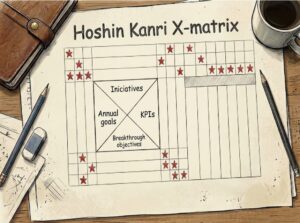
Hoshin Kanri aligns the organisation across three levels: breakthrough objectives (strategic goals for the next three to five years); annual objectives (what should happen this year to advance the long term goals); and improvement projects and initiatives (specific work, owners, and KPIs). The X-Matrix illustrates these connections on a single page. It serves as diagnostic tool, if a project cannot be traced to a breakthrough objective, the team needs to ask themselves, “Why are we doing this?”.
The process to keep the connection between levels reliable, is the Catchball process. The Management proposes the direction, and that proposal travels down through site directors, department heads and team leaders. Team leaders then pass the proposals to their teams, who pass them back up again. Each stage of this process reveals what is actually achievable, what constraints exist that cannot be seen from above, and what resources are needed to close any gaps.
The process to keep the connection between levels reliable, is the Catchball process. The Management proposes the direction, and that proposal travels down through site directors, department heads and team leaders. Team leaders then pass the proposals to their teams, who pass them back up again. Each stage of this process reveals what is actually achievable, what constraints exist that cannot be seen from above, and what resources are needed to close any gaps.
“Goals are negotiated, refined, and aligned rather than imposed. The X-Matrix shows whether what it is being done adds up to something.”
Shop Floor Management: The Behaviour That Sustains It
It is clear that Hoshin Kanri is not an annual planning event. It requires a leadership style that should be intentionally cultivated: regularly visiting the workplace with a sincere curiosity to understand what is actually happening. For those familiarised with Lean Management practices, this is known as “Gemba Walk”.
In the context of pharmaceutical quality, this could refer to the production facilities, laboratory, batch record review process or warehouse, for example. Managers who understand and apply truly lean practices are not there to audit or supervise. They are there to ask, to mentor and to learn: What is getting in the way? Where are competing priorities creating friction for this team? What can this process tell us that the monthly report cannot?
The payoff is direct. Leaders who maintain this discipline make better strategic decisions because they are grounded in reality rather than the reporting structure. Teams also respond differently when they see that leadership is purposefully interested and want to understand the reality of their work. This fosters the kind of trust that transforms Catchball into an authentic and fruitful dialogue and make Hoshin Kanri a powerful management tool.
“The best and most efficient strategic decisions come from leaders who have spent time in spaces where quality and real value is created, not just reviewed.”
GMP Environments: Three Practical Considerations
Establish compliance as the lowest standard, not the highest.
Experience shows that in regulated environments, like pharma and biotech industries, there is a temptation to treat GMP compliance, including inspection readiness, deviation management, and licence maintenance, as a strategic objective in itself. However, these are the operational baseline, these are the standards that must be maintained regardless of anything else on the X-Matrix. Breakthrough objectives exist beyond compliance. The most powerful approach is to build a quality system and culture that ensures inspection readiness is a permanent state rather than a periodic mobilisation. This is a breakthrough. “Achieving zero critical findings in the next inspection” is a milestone, not a strategy.
Use CAPA data as strategic intelligence
The CAPA system is one of the most underused sources of insight for pharmaceutical leadership teams. Recurring events, such as the same root causes appearing across multiple deviations, the same departments generating the highest exception rates, and the same supplier categories causing repeated quality issues, indicate where the system is structurally weak. In an effective Hoshin Kanri cycle, this data informs the annual objective-setting process directly. The CAPA system becomes as well a diagnostic tool that keeps the strategy grounded in operational reality rather than being just a compliance requirement. This is a worthwhile shift.
Integrate Catchball in Management Review
For organisations operating under ICH Q10 or ISO 9001 or equivalent frameworks, there is a practical opportunity to integrate rather than add. The Catchball process, maps naturally onto the Management Review cycle. Documenting Catchball outputs within Management Review records creates an audit trail that demonstrates systematic strategic deployment, thereby embedding the process within existing governance rather than running it as a parallel system competing for the same calendar. Two objectives, one process.
Measuring Outcomes with the Bowler Chart
Without regular reviews, plans become documents. The Hoshin Kanri review cadence uses a Bowler Chart. This is a simple month by month scorecard showing actual performance against planned milestones for each objective. Green means on track. Red indicates that something needs attention.
The discipline lies in how the red cells are handled. The question of who is responsible for missing a milestone is never asked. Instead, the focus is on identifying what has changed, what the team needs, and how leadership can remove the obstacle. This approach transforms the monthly review from a performance assessment into a problem-solving conversation. This is meaningful.
For organisations subject to inspection, the Bowler Chart offers an extra advantage in that it creates a record of the strategic decision making process and the information available at each stage. This is evidence when an inspector asks: how do you make sure that the quality and safety objectives are under control?
— key takeaways
- Hoshin Kanri bridges the gap between strategic intent and daily work, making the connections between the two explicit and visible at every level.
- Catchball is the core for all system to work, objectives are tested against operational reality before finalisation, rather than after targets have been missed.
- In GMP environments, compliance should be the baseline. Breakthrough objectives should be built above this baseline to create a quality culture and robust systems that ensure excellence becomes a permanent state.
- CAPA data is strategic intelligence. Use it to inform the annual planning cycle, not just to fulfill regulatory obligations.
- A leadership presence on the shop floor is not just a cultural aspiration. It is a practical requirement for making sound strategic decisions in complex operational environments.